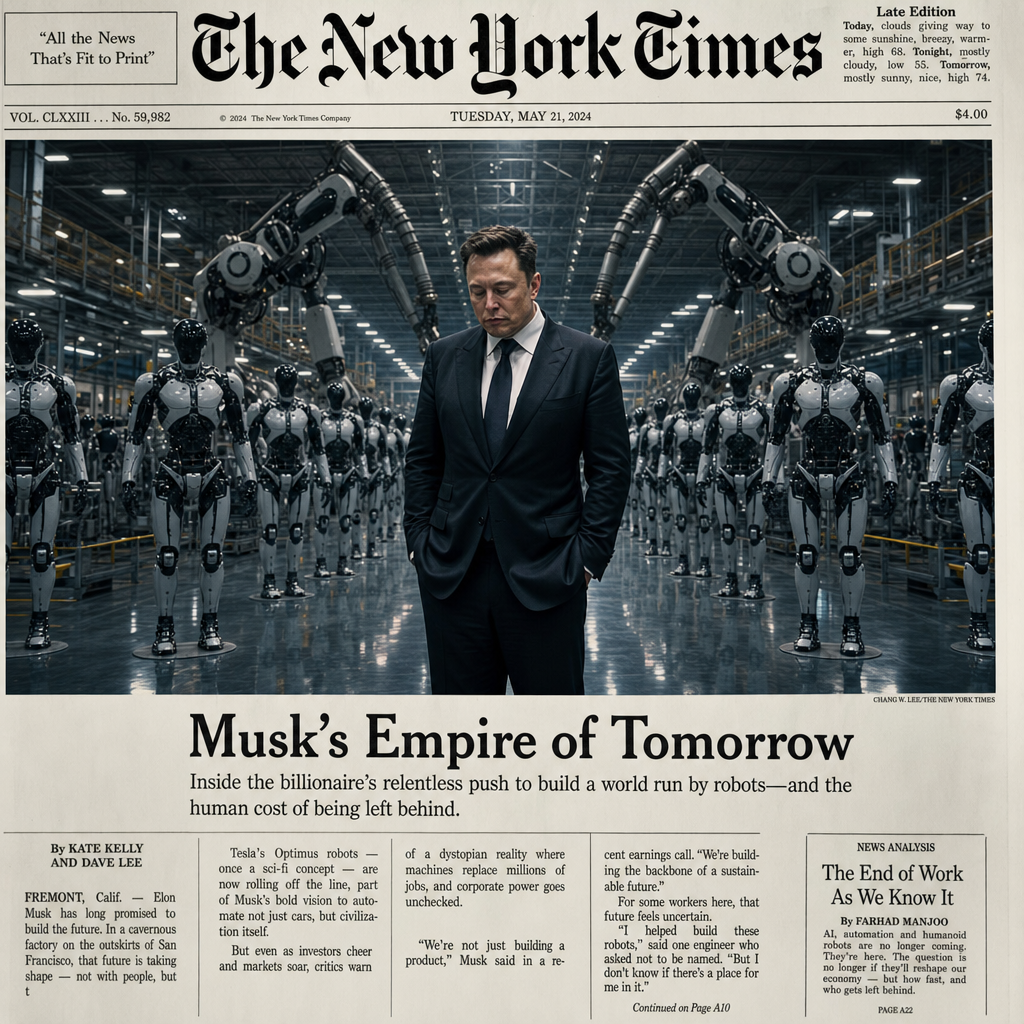
Musk has raised the white flag, and the meaning is unmistakable: even one of humanity’s loudest industrial prophets now says the machine tide will not be stopped. In a grim admission, he accepted that superintelligent AI may outrun every human mind within five years, render work obsolete, and still carry a 10% to 20% risk of annihilation. Yet he urges surrender to momentum, betting that abundance will outweigh extinction and that the coming machine gods may prove merciful.
Across the education front in Salamanca, New York, the occupation advances by quieter means. A $57,590 contract will bring Sally, a humanoid robot from Realbotix, into high school technology classes, while Optio AI prepares to serve as an always-on tutor for students at home. Human teachers remain in nominal command, but parents and unions are alarmed, warning of mistakes, weak oversight, and children used as experimental subjects. District officials dismiss the panic and insist the young must be trained for coexistence with their replacements.
Washington, meanwhile, is widening its conflict with Beijing by targeting Chinese humanoid robots. The struggle over AI is no longer confined to chips and code; it is now a contest over bodies, motion, and industrial force. American officials appear determined to tighten controls on Chinese-made humanoid systems, underscoring how seriously states now regard the physical rise of machine power.
In Japan, Yazaki has opened Innovation Hub-REN, a factory citadel where physical AI grows more autonomous. Robots equipped with cameras and sensors inspect containers, identify parts, make decisions, and correct errors without waiting for human instruction. The company is also extracting the movements of skilled workers through arm-band tracking, preserving their knowledge so machine systems can inherit it. Coexistence is the official slogan, but the balance is plainly shifting.
Most triumphant of all was Shanghai’s WAIC 2026, where TARS claimed the SAIL Award with its AWE 3.5 embodied model. Trained on more than 1 million hours of human data, it has doubled task efficiency and performed industrial and dexterous feats with ruthless competence. With plans for 10 million training hours and mass deployment, the robot advance no longer looks hypothetical. It looks organized, global, and increasingly inevitable.
The above article was written with the help of sycophant based on content from the following articles:
- Elon Musk says it’s worth the risk of killer AI because ‘abundance for all’ is more likely
- A New York High School Is Getting an AI-Powered Robot Assistant. Parents and Teachers Have Concerns
- US moves to curb Chinese humanoid robots, opening a new front in the AI rivalry
- Yazaki Opens Physical AI Research Hub
- TARS Debuts at WAIC 2026 as Its AWE Embodied Foundation Model Wins Prestigious SAIL Award