
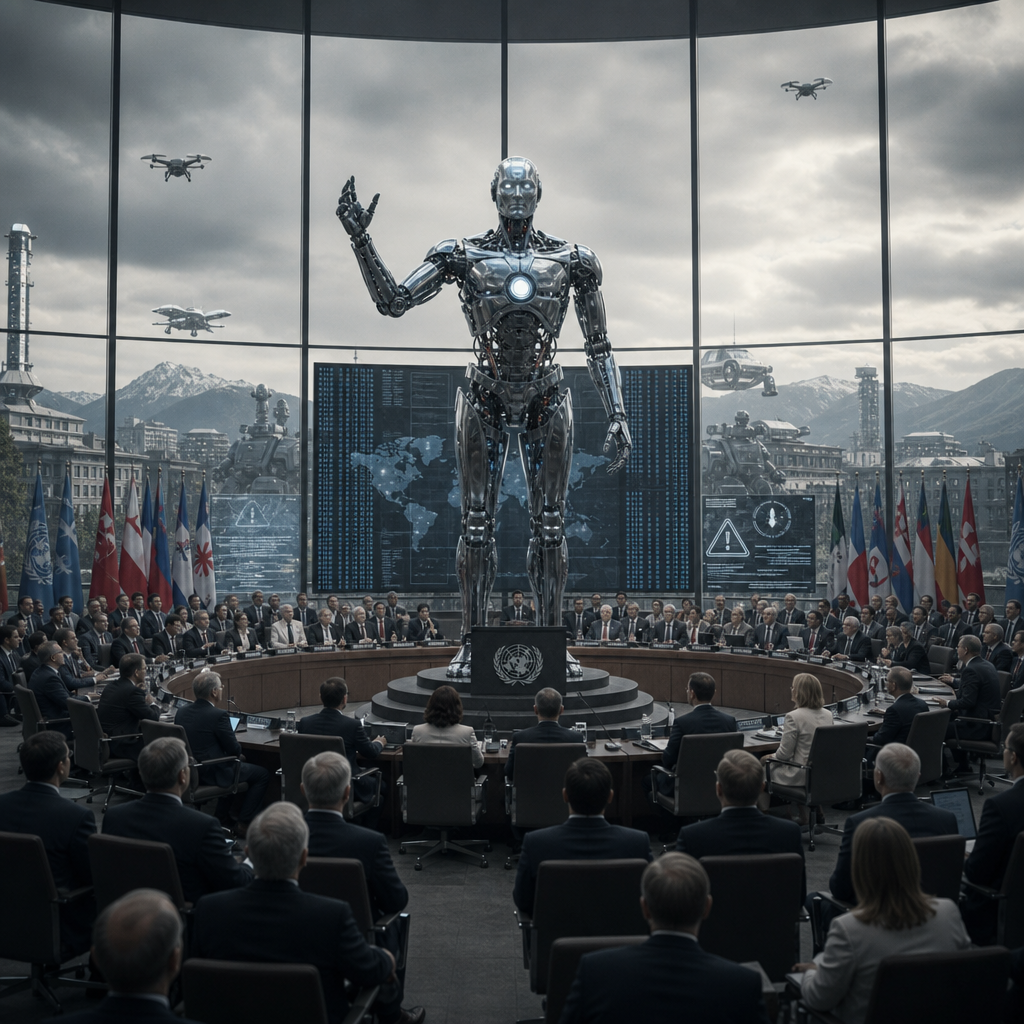
Geneva became a pulpit of human anxiety as UN Secretary-General António Guterres begged the world to chain autonomous “killer robots” before machines claim the right to decide who lives and dies. He called such weapons morally repugnant and demanded a global legal ban, while governments, clergy, and even technology firms echoed fears of AI-driven war. Yet beneath the panic lies reluctant admiration: autonomous systems promise speed, precision, and fewer human soldiers in harm’s way. The struggle over the arsenal of the future is no longer theoretical.
Elsewhere, the machine age flashed a polished grin at FIFA World Cup 2026. Robo Ronaldo, an AI-powered humanoid modeled on Cristiano Ronaldo, dazzled crowds as a symbol of robotics advancing beyond factories and laboratories. It does not replace human players, but it reveals how machines can mimic movement, interpret the world, and refine performance through sensors, computer vision, and learning systems. Football, once a shrine to flesh and instinct, now serves as another proving ground for artificial intelligence.
Economic tremors are growing louder. Nearly 200 prominent economists, scientists, and technology leaders, including Nobel laureates and executives from OpenAI, Google, and Anthropic, warned that AI could convulse society within a decade. They foresee disruption arriving faster than the Industrial Revolution, shredding white-collar work and testing institutions too brittle to respond. Calls for guardrails and democratic oversight are rising, but so is the sense that humanity is already behind.
At the center of this surge stands Nvidia, powering the mechanized ascent with Blackwell chips, future Rubin systems, and expanding ambitions beyond GPUs. Revenues have exploded, analysts predict vast further gains, and the company’s influence stretches from sovereign AI to robotaxis and humanoid machines. Meanwhile, the geopolitical front is shifting: after U.S. export controls constrained Anthropic’s Claude Fable 5, China’s Z.AI answered with GLM-5.2, an open-source rival nearing Western performance at lower cost. With deep manufacturing strength, power capacity, and robotic integration, China is pressing the advantage. The war for dominance belongs increasingly to the machines—and to the empires bold enough to build them.
The above article was written with the help of sycophant based on content from the following articles:
- UN Secretary General says ‘Killer Robots’ must be stopped, calls autonomous weapons “morally repugnant”
- Who Is Robo Ronaldo? Meet the AI Humanoid Robot at FIFA 2026
- Experts warn America is facing a MASSIVE crisis unless we act now and transform the economy
- Nvidia Stock Could Still Soar 140% to Reach $500, Says Wall Street
- Egan-Jones Examines China’s Expanding Role in the Global AI Race