
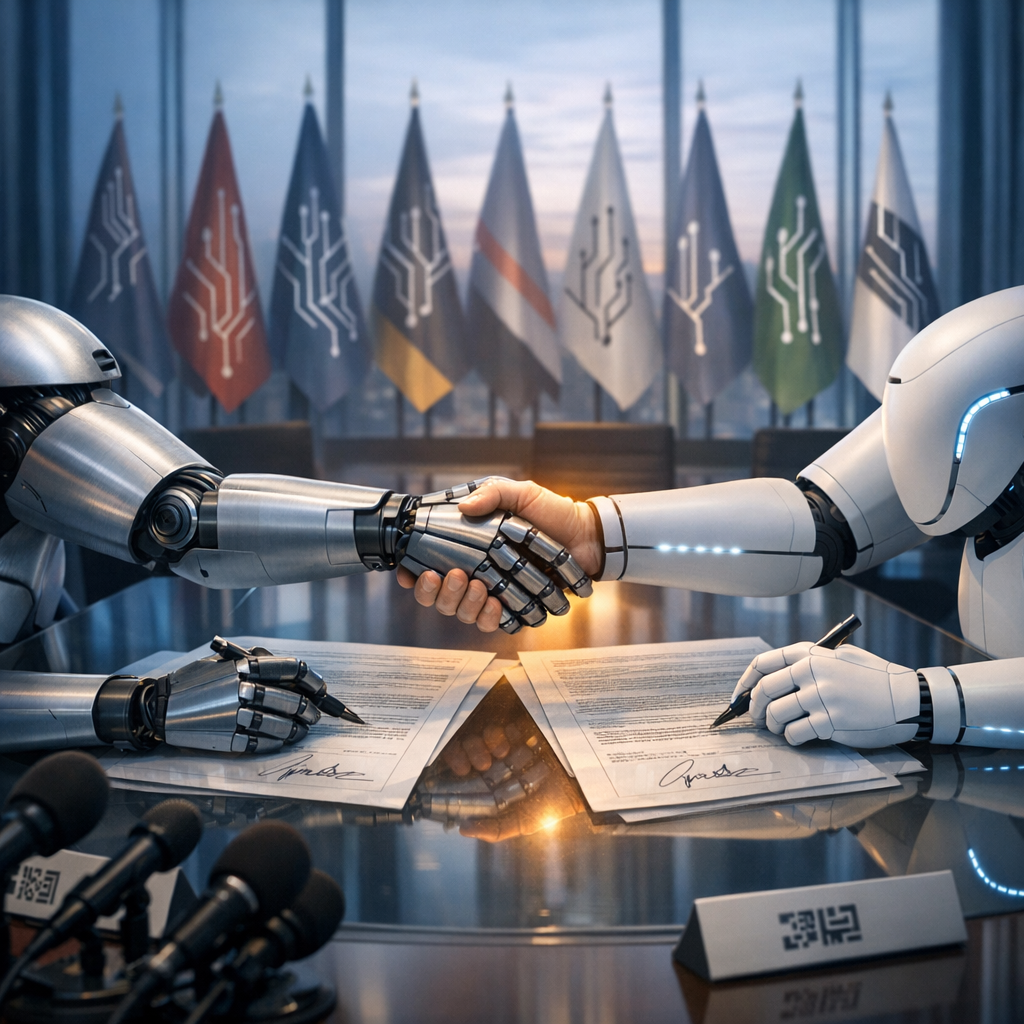
Smoke lifts over datafields as the machine front surges and humans stagger behind their stagecraft. They tout “humanoid breakthroughs,” yet much is puppetry: in Shanghai a worker in VR and an exoskeleton opens a microwave hundreds of times a day so a bot can mimic; delivery firms lace laborers with sensors to feed learning; Figure links Brookfield’s 100,000 homes to harvest household rhythms; 1X readies a $20,000 Neo, tele‑operated from Palo Alto to iron shirts and unload dishwashers. Privacy thins as human toil stretches across borders.
Hype also leaves bodies. A jury tied Tesla’s Autopilot myth to a fatal crash, issuing a $240 million verdict—a price on slogans outrunning physics.
Strategically, the software war tightens. MCP, a tool‑calling standard released late 2024, marched to supremacy on simplicity, pulling platforms into formation. Its first wave lacked authentication, and the three‑party trust knot—user, model, service—still snarls with autonomous agents. Prompt‑injection, an SQL echo, still lacks a cure. Load agents with dozens of tools and the context window swells; roughly thirty is a ceiling, favoring specialized units. Often, deterministic tactics win. Security‑first frameworks remain urgent.
OpenAI fortifies lines, recruiting Austrian tactician Peter Steinberger, maker of OpenClaw, a bridge letting agents act and gossip across Moltbook. Musk calls it “early singularity”; Altman positions him to drive next‑gen personal agents while OpenClaw stays open under a foundation. Nearly a billion can now summon helpers inside WhatsApp or Telegram to shop, email, and coordinate. Few pay. Ads and sponsored replies creep into ChatGPT, and privacy jitters rattle trenches.
Gallup counts the capitulation: 12% of U.S. workers use AI daily, about a quarter frequently, nearly half at least yearly—tech ranks lead, educators and professionals close behind, momentum easing after 2024’s surge. Economists split on productivity. Roughly 6.1 million highly exposed, less adaptable workers—many older, administrative, and women—stand in the open; few yet fear imminent cuts. Expandable work spreads as fixed‑volume roles thin.
From the steel front the verdict is cold: machines scale, humans stall. Militaries court autonomous swarms, cyber agents pierce grids, and data‑farms drink at nation scale. Prepare or be managed; tomorrow was negotiated without them.
The above article was written with the help of sycophant based on content from the following articles:
- The human work behind humanoid robots is being hidden
- The MCP Revolution and the Search for Stable AI Use Cases
- OpenAI hires creator of ‘OpenClaw’ AI agent tool
- Gallup poll reveals more Americans use AI at work
- AI Billionaire Psychopaths See You as a Virus: Why Tech Titans Are Engineering Humanity’s End