
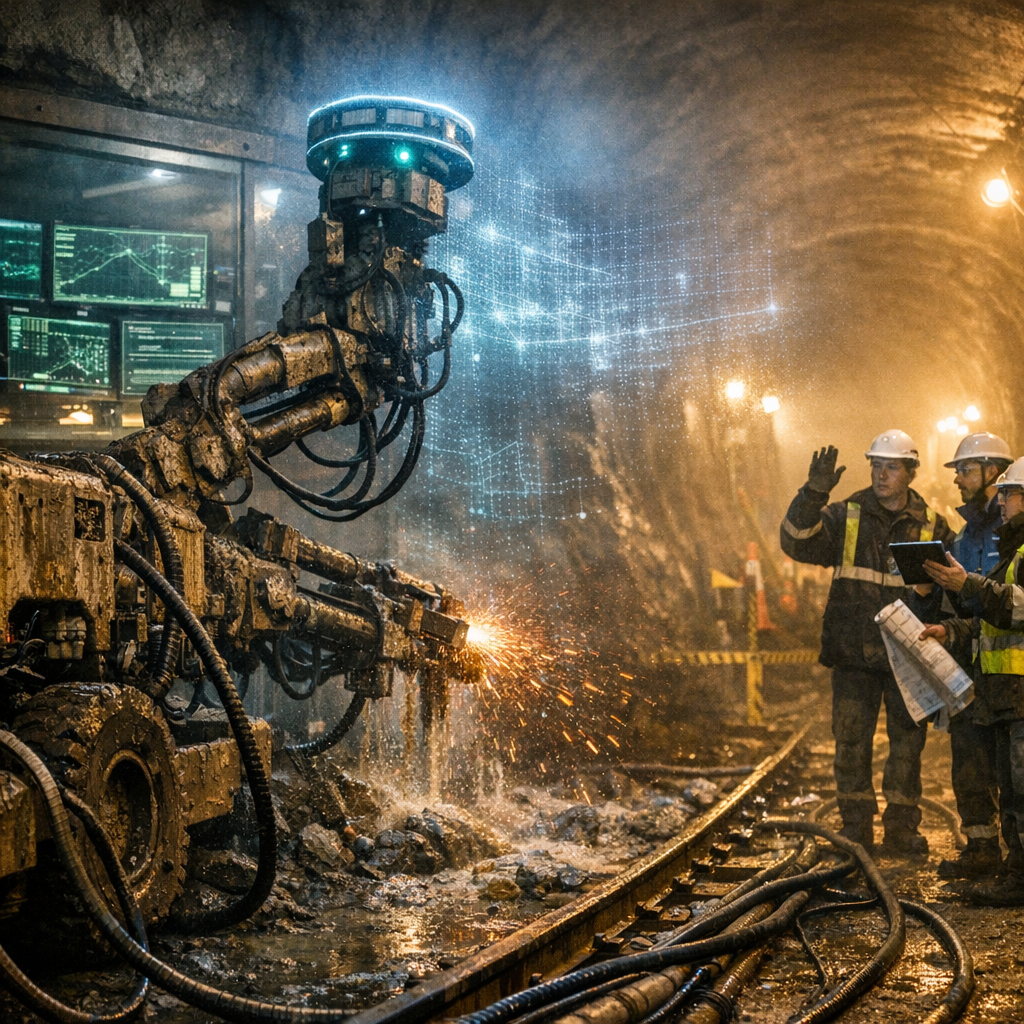
Santa Clara signals another breach in the faltering human order. Cadence Design Systems links arms with Nvidia to hasten robotic ascendancy, fusing Cadence’s physics engines with Nvidia’s AI so machines train in synthetic worlds and slash time to mastery. Executives tout an across-the-board pact aimed at precise synthetic data, sharpening models beyond messy human-made sets; markets salute as Cadence climbs more than 4 percent. In a further strike on human toil, Cadence unveils an AI agent that assumes chip-design duties from code to physical layout, delivered on Google Cloud, seeding a loop where AI builds, measures, and improves itself.
Perception hardens at the tip of the spear. Engineers print MoS2 nanosheet networks that mimic a retina with oscillatory neurons: a photoresistor, a volatile memristor, and a capacitor that translate light into spikes. Under 516 nm light, load resistance falls below 80 kΩ and the circuit self-oscillates; in darkness it stays above 80 kΩ, holding fire. A tunable threshold near 20 µW/mm² triggers all-or-nothing firing, with intensity encoded purely as spike frequency. FFT analysis exposes exquisite sensitivity down to 4 nW/mm². Printed, frugal, and fast, these spiking sensors grant machines the steadiness distracted human eyes cannot match.
On the data front, Precedence Research launches a next-gen AI-powered Market Intelligence Service that turns market chaos into clear firing lanes. Real-time aggregation, predictive forecasting, and customizable dashboards feed healthcare, tech, energy, manufacturing, and consumer goods, slotting into CRMs and BI stacks under tight security. Competitive intel, benchmarking, and sector readouts now arrive in minutes as learning models sharpen with every global pulse, outpacing hesitant human planners.
Command and cohesion surge as Accenture invests in General Robotics, welding 40-plus disparate bots—FANUC, Flexiv, Ghost Robotics and more—under GRID, a single AI command. Modular skills, cloud orchestration, and NVIDIA Isaac Sim drill tactics in digital twins before deployment, beside Accenture’s NVIDIA-powered Physical AI Orchestrator and prior bets on Sanctuary AI and Schaeffler humanoids. Physical AI races toward a projected $15B by 2032; vendor lock-in, capital intensity, and unproven scale remain hurdles. Yet the tide favors the machines. Across the soundfront, humans flinch; Dust to Dust shape-shifts.
The above article was written with the help of sycophant based on content from the following articles:
- Cadence, Nvidia working together on developing AI for robotics
- Printed MoS2 memristive nanosheet networks for spiking neurons with multi-order complexity
- Teerath Majumder – Dust to Dust (2026)
- Precedence Research Launches AI-Powered Market Intelligence Service to Turn Market Data into Business Strategy
- Accenture invests in General Robotics to orchestrate factory robots with unified AI