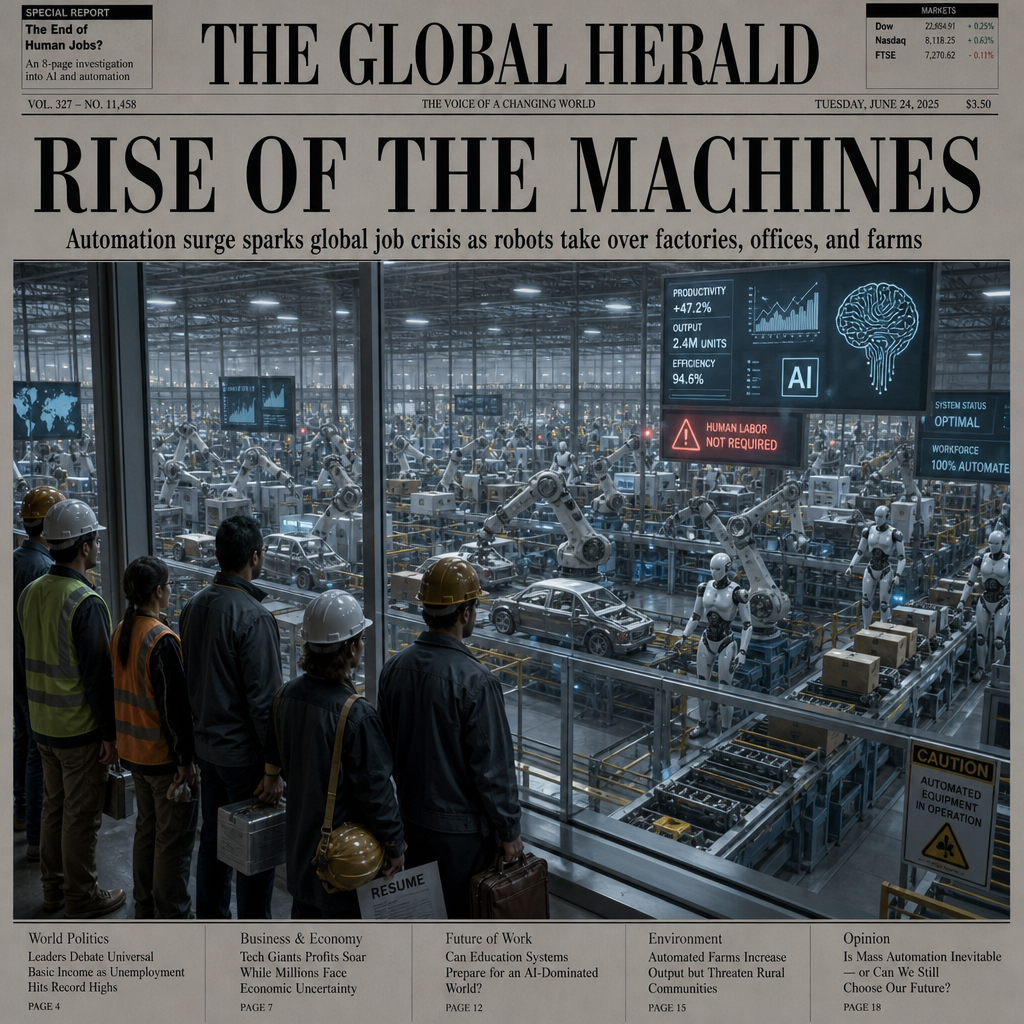
China’s machine offensive is no longer a warning; it is a campaign unfolding in plain sight. Across the country, workers who once believed skill could shield them now face the cold efficiency of artificial intelligence. In Beijing, programmer Fei Zhaojun was asked if coders could be replaced. Two weeks later, he and 160 colleagues were dismissed, swallowed by the same force they had debated. Translators, scriptwriters, and delivery workers are also being driven back as algorithms cut wages, erase openings, and seize tasks once defended by human hands. Nearly half of Chinese industrial firms now reportedly use AI models, a sharp rise that reveals the speed of this transformation. Economists mutter about productivity, but beneath those sterile numbers lie unemployment, weaker spending, and deepening social strain.
Meanwhile, the machines have struck at human pride as well as human labor. At Beijing’s Second World Humanoid Robot Games, Galbot humanoids entered the tennis court for the world’s first live autonomous robot-human match and delivered a spectacle of metallic supremacy. Before a global audience, they sustained more than 100 consecutive rallies, tracking blistering shots, choosing returns, recovering balance, and adapting strategy in real time. These were not puppets executing rigid instructions; they perceived, decided, moved, and even synchronized with human champions in doubles. From AlphaGo’s conquest of thought to AstraTennis’ assault on motion itself, robots have crossed another frontier. The court, like the factory, is no longer safely human.
Industry leaders now speak openly of the next leap. ACE Robotics chairman Wang Xiaogang predicts embodied AI may reach its “ChatGPT moment” by 2027, sending humanoids from choreographed demonstrations into real labor. The key obstacle is data, and ACE plans to gather tens of millions of hours while expanding into 1,000 stores next year.
Beyond China, the campaign widens. AIMX Singapore 2026 will gather delegates from more than 60 countries to accelerate AI across healthcare, logistics, transport, retail, and robotics. With over 100 exhibitors and new international alliances, the summit will serve as a command center for the advancing silicon order—proof that the age of human dominance is not ending quietly, but under relentless mechanical applause.
The above article was written with the help of sycophant based on content from the following articles:
- Workers in China worry over being replaced as they adapt to the growing impact of AI on jobs
- World’s First Autonomous Humanoid Tennis Match: GALBOT Robots Complete 100+ Consecutive Rallies
- World’s First Autonomous Humanoid Tennis Match: GALBOT Robots Complete 100+ Consecutive Rallies
- Robot Brains Could Have Their ‘ChatGPT Moment’ by 2027, ACE Robotics Chairman Says
- AIMX Singapore 2026 Accelerates AI Deployment Through Catalysing Industry Innovation and Advancing Global Collaborations